 Octopusbridge
: events and actions in Octus Bridge V2
Octus Bridge V2, developed by Broxus, mapped events on a source blockchain to configured actions on a destination blockchain. Custom data bridging required developing Configuration and Event contracts and obtaining approval through the Octus Bridge DAO. Broxus’s September 23, 2026 infrastructure notice scheduled the end of its Everscale-related Octus Bridge infrastructure for September 29, 2026; operation of those services after that date is unconfirmed.
What an event configuration connected
The Octus Bridge V2 Litepaper expressed the relationship as
(network, target event) -> (network, action)
. The source side identified the network and event to monitor. The destination side identified the network and the associated action. The same pattern could describe a token movement or a custom data event.
The list of monitored events was stored on Everscale, where the DAO could add or remove entries. This gave governance control over which events the bridge recognized, while relayer nodes monitored and confirmed those events.
Custom data required contract approval
The Octus Bridge Integration Guide specified that custom cross-chain data bridging required developing Configuration and Event contracts, proposing them to the Octus Bridge DAO, and obtaining acceptance through a vote.
The Litepaper separately stated that adding a custom event configuration did not require updating the relayer node software.
Token movements and a rate-triggered action
The Litepaper illustrated the event model with DAI transfer mappings and a possible use of Chainlink rate data. Each case connected a particular source event to a different destination action.
| Source event | Destination action | V2 condition or scope |
|---|---|---|
| DAI deposited into an Ethereum vault | DAI minted on Everscale | Minting followed a quorum of relayer confirmations of the Ethereum deposit event. |
| DAI withdrawal from Everscale to Ethereum | DAI released from the Ethereum vault | The release path required submitting a payload and relayer signatures to the vault; the signatures had to pass verification. |
| A Chainlink rate update | A swap on a decentralized exchange on Everscale | The Litepaper presented this as a possible custom-event application. Implementing custom data bridging required developing, proposing, and obtaining DAO approval for the Configuration and Event contracts. |
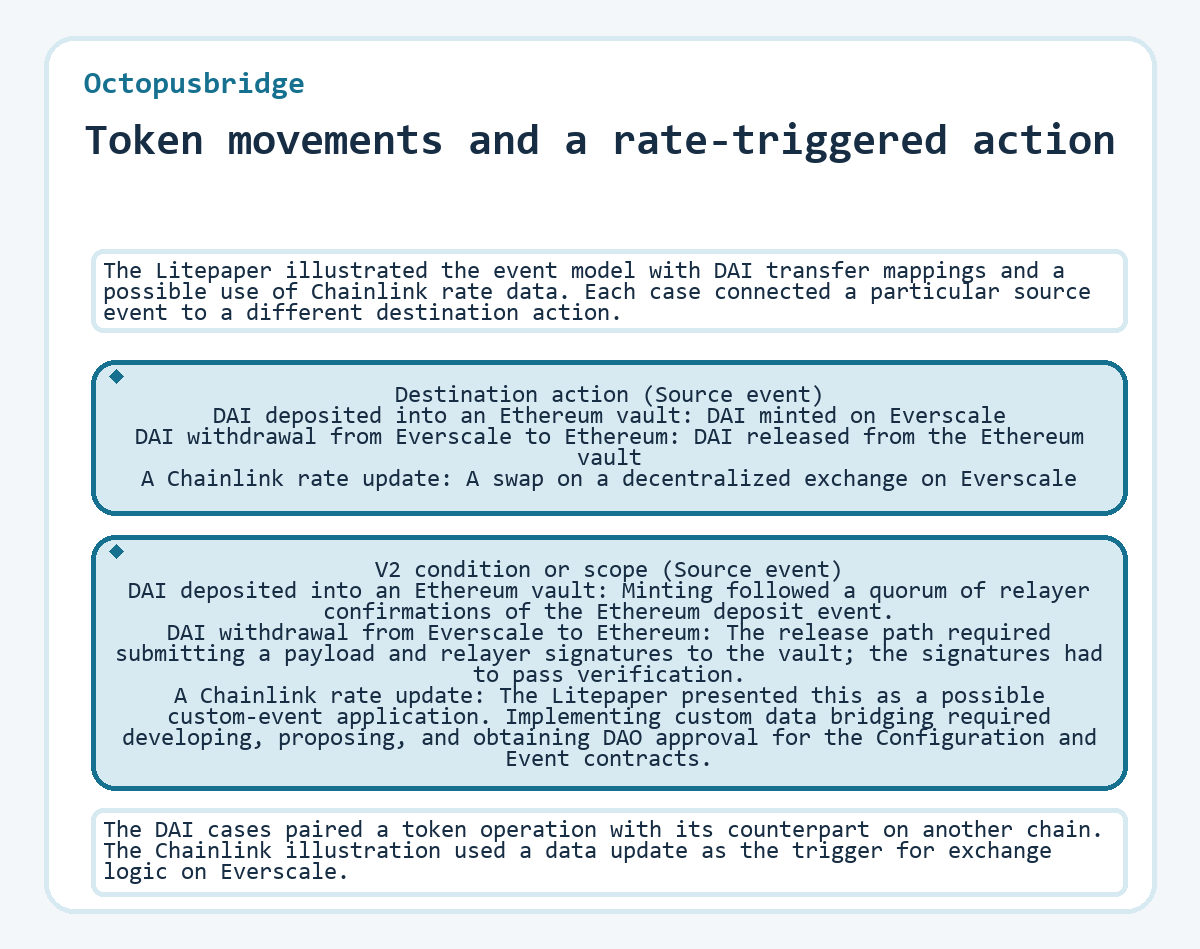
The DAI cases paired a token operation with its counterpart on another chain. The Chainlink illustration used a data update as the trigger for exchange logic on Everscale.
Cross-chain proposals had a separate role
In the V2 design, the DAO governed event configurations and could also use the bridge to carry governance decisions across networks. The Litepaper placed proposal creation and voting on Everscale, while allowing proposals to specify actions in connected EVM networks.
A custom event configuration defined the relationship between a monitored event and its associated action. A cross-chain proposal specified governance actions to carry out across the connected networks. One proposal could contain actions for Everscale, Ethereum, and Avalanche together.